This guide is for people who know some Python and want to understand how neural networks work, then train them with PyTorch or TensorFlow. Every option is on Udemy, and I read every fact on the course page.
- Best overall: Mike X Cohen's A deep understanding of deep learning, 57.5 hours in PyTorch with a Python introduction, rated 4.8.
- For PyTorch projects: the PyTorch for Deep Learning Bootcamp by Daniel Bourke and Andrei Neagoie, 52 hours for beginners.
- Shortest start: Deep Learning A-Z, 23 hours with nearly 50,000 reviews.
- For TensorFlow: Lazy Programmer's Tensorflow 2 course, applied to computer vision and time series.
| Course | Level | Length | View course |
|---|---|---|---|
| A deep understanding of deep learning (with Python intro) Udemy Best overall | Beginner | 57.5 h | View course |
| PyTorch for Deep Learning Bootcamp Udemy For PyTorch projects | Beginner | 52 h | View course |
| Deep Learning A-Z [2026]: DL, AI in Python & AWS + LLM Prize Udemy Shortest start | All levels | 23 h | View course |
| [2026] Tensorflow 2: Deep Learning & Artificial Intelligence Udemy For TensorFlow | All levels | 26 h | View course |
What a deep learning course teaches
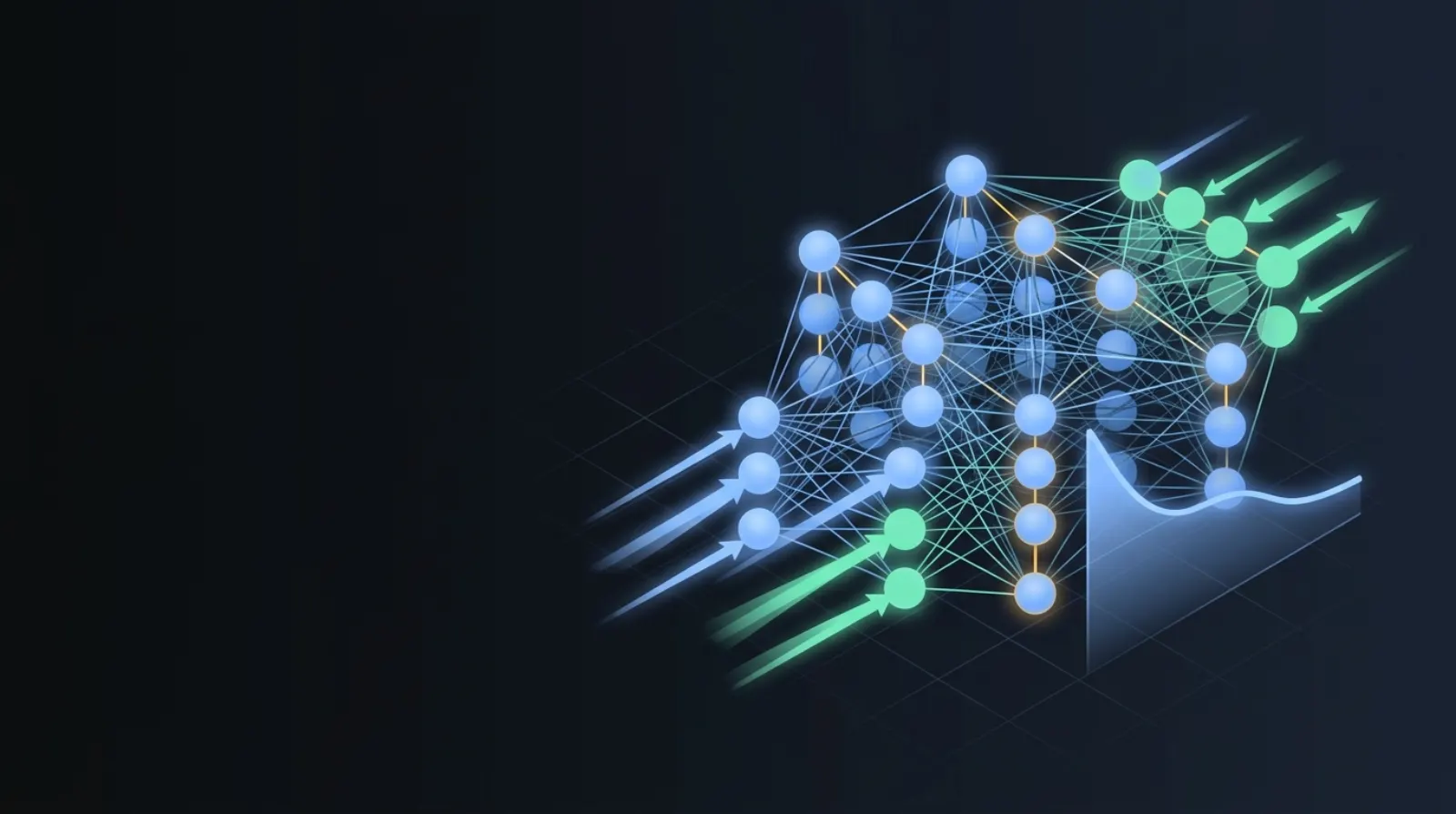
A neural network is layers of units connected by weights: an input layer, one or more hidden layers, and an output layer. Training means adjusting those weights by running the same loop many times:
- Forward pass. Data goes through the network and comes out as a prediction.
- Loss. A function measures how far the prediction is from the right answer.
- Backpropagation. The gradient of the loss is computed for every weight, from the output back to the input.
- Update. An optimizer nudges each weight in the direction that lowers the loss.
On top of that loop, courses cover the main architectures: convolutional networks (CNNs) for images, recurrent networks (RNNs) for sequences, and transformers, the architecture behind today's language models. The code runs on a framework, usually PyTorch or TensorFlow with Keras. Two of the four picks teach PyTorch and one teaches TensorFlow.
Deep learning is outside my field (I work in DevOps), so the only advice I'll add is practical. Training networks on a CPU alone can be slow, so check before you start whether you'll have a GPU, either on your machine or in a cloud notebook.
Mike X Cohen: best overall
A deep understanding of deep learning (with Python intro)
Mike X Cohen • Udemy
57.5 hours of deep learning in PyTorch, taught with an experimental, scientific approach, plus a Python introduction. It's for people who want to understand why networks work as well as how to run them.
- Level
- Beginner
- Length
- 57.5 h
- Certificate
- Completion
- Rating
- 4.8 (6.6k)
- Audio
- English
- Subtitles
- 20 languages, including auto-generated Portuguese
Pros
- Deep learning in PyTorch, taught with an experimental, scientific approach
- Includes a Python introduction
- Highest rating in this guide, updated August 1, 2026
Cons
- 57.5 hours, so it takes a while to finish
It has the best rating in this guide, 4.8 from about 6,600 reviews, and it was updated on August 1, 2026. It is marked for beginners. The trade-off is length, so plan for weeks of study. It has auto-generated subtitles in 20 languages.
Daniel Bourke and Andrei Neagoie: for PyTorch projects
PyTorch for Deep Learning Bootcamp
Daniel Bourke, Andrei Neagoie • Udemy
52 hours of PyTorch, marked for beginners, for people who want to write and train models in one of the two main frameworks.
- Level
- Beginner
- Length
- 52 h
- Certificate
- Completion
- Rating
- 4.6 (6.4k)
- Audio
- English
- Subtitles
- 11 languages, including auto-generated Portuguese
Pros
- 52 hours of PyTorch, marked for beginners
- 4.6 rating from about 6,400 reviews
Cons
- Last updated February 19, 2026
It has a 4.6 rating from about 6,400 reviews. Its last update was February 19, 2026, the oldest among the picks, so I'd check the date on the course page again before starting. The same authors also have a TensorFlow bootcamp, which I did not pick (see how I chose).
Kirill Eremenko and Hadelin de Ponteves: shortest start
Deep Learning A-Z [2026]: DL, AI in Python & AWS + LLM Prize
Kirill Eremenko, Hadelin de Ponteves, SuperDataScience Team, Ligency • Udemy
23 hours, less than half of Mike X Cohen's course, and nearly 50,000 reviews. It's for people who want to build their first models in Python quickly and decide later whether to go deeper.
- Level
- All levels
- Length
- 23 h
- Certificate
- Completion
- Rating
- 4.6 (50k)
- Audio
- English
- Subtitles
- 21 languages, including auto-generated Portuguese
Pros
- 23 hours, the shortest course in this guide
- Nearly 50,000 reviews, updated June 13, 2026
Cons
- Less than half the video time of Mike X Cohen's course, so less room for depth
It is marked for all levels and was updated on June 13, 2026. With less time per topic, it goes into less depth than the two PyTorch courses above.
Lazy Programmer: for TensorFlow
[2026] Tensorflow 2: Deep Learning & Artificial Intelligence
Lazy Programmer Inc. • Udemy
26 hours of TensorFlow 2 applied to computer vision and time series, with 2 practice tests. The pick if your team or your target job uses TensorFlow.
- Level
- All levels
- Length
- 26 h
- Certificate
- Completion
- Rating
- 4.7 (14k)
- Audio
- English
- Subtitles
- 3 languages
Pros
- TensorFlow 2 applied to computer vision and time series
- 4.7 rating from more than 14,000 reviews
- Includes 2 practice tests
Cons
- Last updated March 24, 2026
It has a 4.7 rating from more than 14,000 reviews and was updated on March 24, 2026. It has subtitles in only 3 languages.
How I chose
I used the same methodology as every other guide. For this topic four things mattered: depth on how networks train, the framework used, updates in 2026, and the number of reviews. For now I only compare courses on Udemy. I read every fact on the course page on September 28, 2026.
I left out Jose Portilla's PyTorch for Deep Learning with Python Bootcamp, last updated in September 2023, and his Complete Tensorflow 2 and Keras Deep Learning Bootcamp, last updated in June 2022. The TensorFlow for Deep Learning Bootcamp by Daniel Bourke and Andrei Neagoie (63 hours, updated February 2026) was close, but Lazy Programmer's course has a higher rating and more reviews.
Frequently asked questions
PyTorch or TensorFlow?
If you have no reason to pick one, start with PyTorch, since two of the four courses here use it. Pick TensorFlow if your team or the jobs you want already use it. The ideas (layers, loss, backpropagation) carry over from one to the other.
Do I need math?
It helps to know what a derivative and a matrix are, because backpropagation and layers are built on them. You do not need to be fluent before you start.
Should I learn machine learning first?
Deep learning is a part of machine learning. If you have never trained any model, a machine learning course first makes the ideas of training, validation and overfitting easier to follow.
How long does it take?
The picks range from 23 to 57.5 hours of video. Add the time to run and change the code yourself, which is where most of the learning happens.
Do the courses have subtitles?
Yes, all of them are auto-generated. Mike X Cohen's course has 20 languages, the ZTM PyTorch course 11, and the one by Kirill Eremenko and Hadelin de Ponteves 21, Portuguese included in all three. Lazy Programmer's course has 3 languages, none of them Portuguese.